
Israel Attacks South Pars Gas Field as Iran Hit Gulf Energy Sites in Retaliation
Key Takeaways
- Israel attacked the South Pars gas field, one of the world’s largest gas reserves.
- Iran retaliated with missile and drone strikes against Gulf energy sites.
- Arab and Islamic states urged restraint and respect for international law.
Initial Attacks
Israel launched an attack on Iran's South Pars gas field, one of the world's largest natural gas reserves.
“Qatar expressed its strong condemnation and denunciation of the Israeli attack that targeted military facilities in southern Syria, while Jordan called on Israel to halt its attacks on Syrian territory”
Iran immediately retaliated by targeting Gulf energy facilities across multiple countries.

Iranian Revolutionary Guards announced counterstrikes targeting Saudi and UAE refineries as well as Qatar's Ras Laffan LNG complex.
Officials urged civilians to evacuate affected areas as the escalation began on February 28.
Iranian media reported the Israeli attack on South Pars occurred with US consent.
Iran's retaliatory campaign included strikes on Iraq's Majnoon oilfield, UAE's Shah gasfield, and Fujairah port.
Energy facilities in Saudi Arabia, Qatar, Kuwait and Bahrain were also targeted.
The attacks caused fires and operational disruptions at multiple sites.
Energy Infrastructure Impact
Iran's retaliatory strikes significantly impacted Gulf energy infrastructure and global markets.
Qatar reported three fires at the Ras Laffan LNG facility that were later contained without injuries.

Abu Dhabi temporarily shut down the Habshan gasfield and Bab oilfield due to falling debris.
Saudi Arabia intercepted multiple ballistic missiles and a drone targeting eastern gas facilities.
Additional strikes were reported toward Riyadh as the conflict escalated.
The attacks endangered maritime traffic through the Strait of Hormuz.
A ship burned off the UAE coast and another was damaged near Qatar.
The Strait of Hormuz handles a fifth of the world's oil shipments.
Iran insisted the waterway remained open, but transit slowed significantly.
Over 20 vessels have reportedly been attacked since the conflict began.
International Response
The international community responded strongly to the escalating conflict.
“Iran has stepped up its retaliatory strikes in the Gulf, directing missile and drone strikes at energy facilities in Saudi Arabia, the UAE, Qatar and Kuwait in response to Israeli attacks on its South Pars gasfield, one of the world’s largest reserves of natural gas”
12 Arab and Islamic states called on Iran to 'immediately halt its attacks' and respect international law.
The joint statement was issued from Riyadh by ministers representing multiple countries.
These ministers condemned Iran's attacks on Gulf states, Jordan, Azerbaijan and Turkey.
They said the attacks targeted 'residential areas, civilian infrastructure, including oil facilities'.
Qatar's Emir Sheikh Tamim bin Hamad Al Thani spoke with French President Emmanuel Macron.
Both leaders described Iran's actions as a 'dangerous escalation'.
They warned the situation threatens regional stability and global energy security.
The UAE Foreign Ministry warned of direct threats to global energy supplies and regional security.
Potential environmental damage and risks to civilians were cited as concerns.
Market Reactions
Global markets reacted sharply to the Middle East energy crisis.
Oil prices surged above $110 per barrel as the conflict disrupted energy supplies.
Brent crude reached $110.90 and US crude hit $99.78 after Iranian strikes.
Asian stock benchmarks declined significantly across multiple markets.
Japan's Nikkei 225 fell 2.7%, South Korea's Kospi lost 2.6%.
Hong Kong's Hang Sang and Taiwan's Taiex both dropped 1.4%.
US President Donald Trump claimed the US knew 'nothing' about Israel's attack on South Pars.
Trump stated Qatar was 'in no way, shape, or form, involved with it.'
He described Iran's strike on Qatar's LNG facility as 'unjustifiable and unfair.'
Trump warned the US would respond by 'massively blow up the entirety of the South Pars Gas Field.'
Iran's parliament speaker warned that attacking Iranian oil infrastructure 'means suicide for them.'
He stated 'the equation of an eye for an eye is in place, and a new level of conflict has begun.'
More on Syria
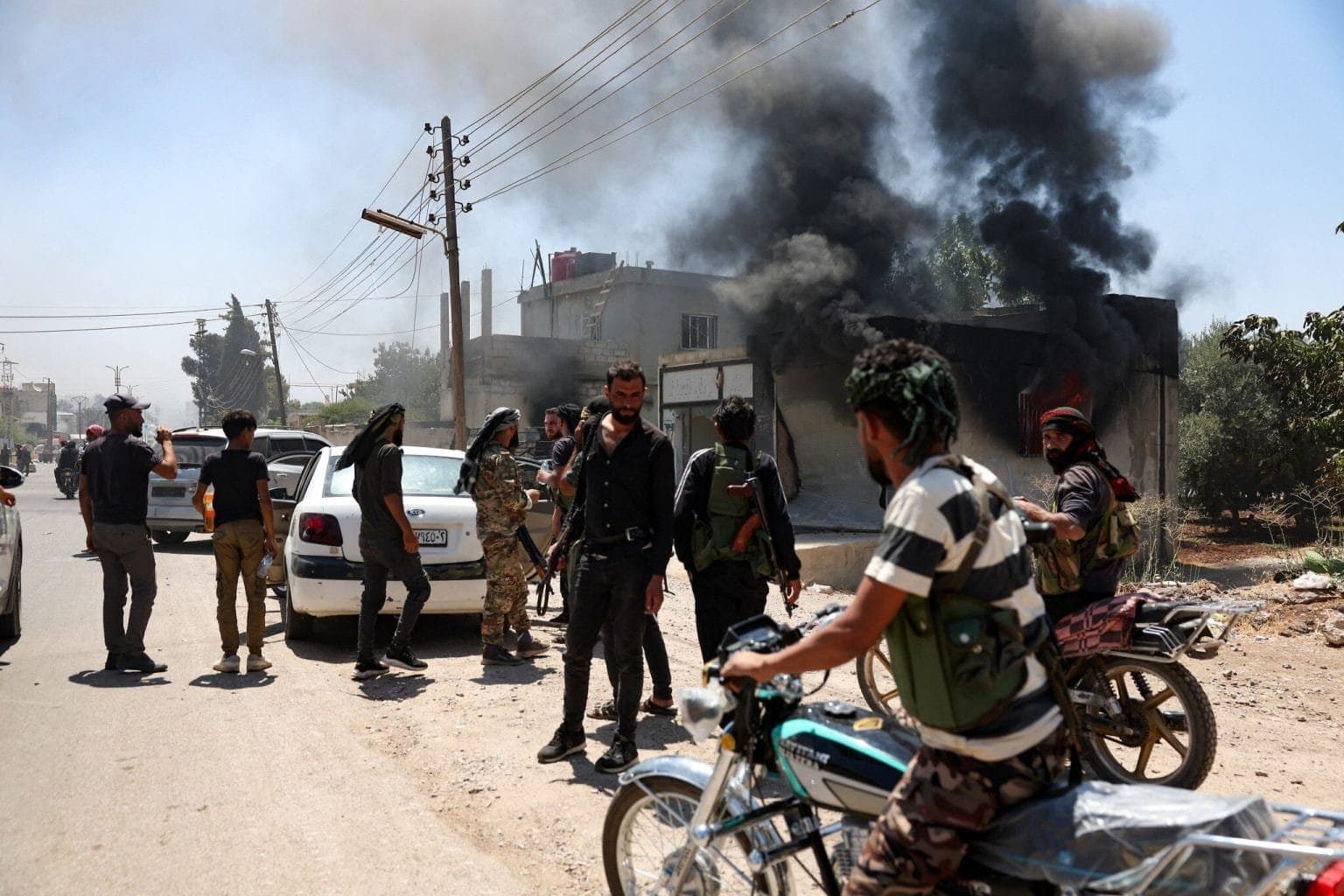
Israel Strikes Syrian Army Camps After Druze Attacks, IDF Says
17 sources compared
US and Israel Kill Iran's Supreme Leader in Wide-Ranging Strikes
24 sources compared

Israel's Strikes on Lebanon Force Tens of Thousands Back Into Syria as Crossings Reopen
14 sources compared

Syria Deploys Army Units Along Lebanon And Iraq Borders, Says Measure Is Defensive
16 sources compared