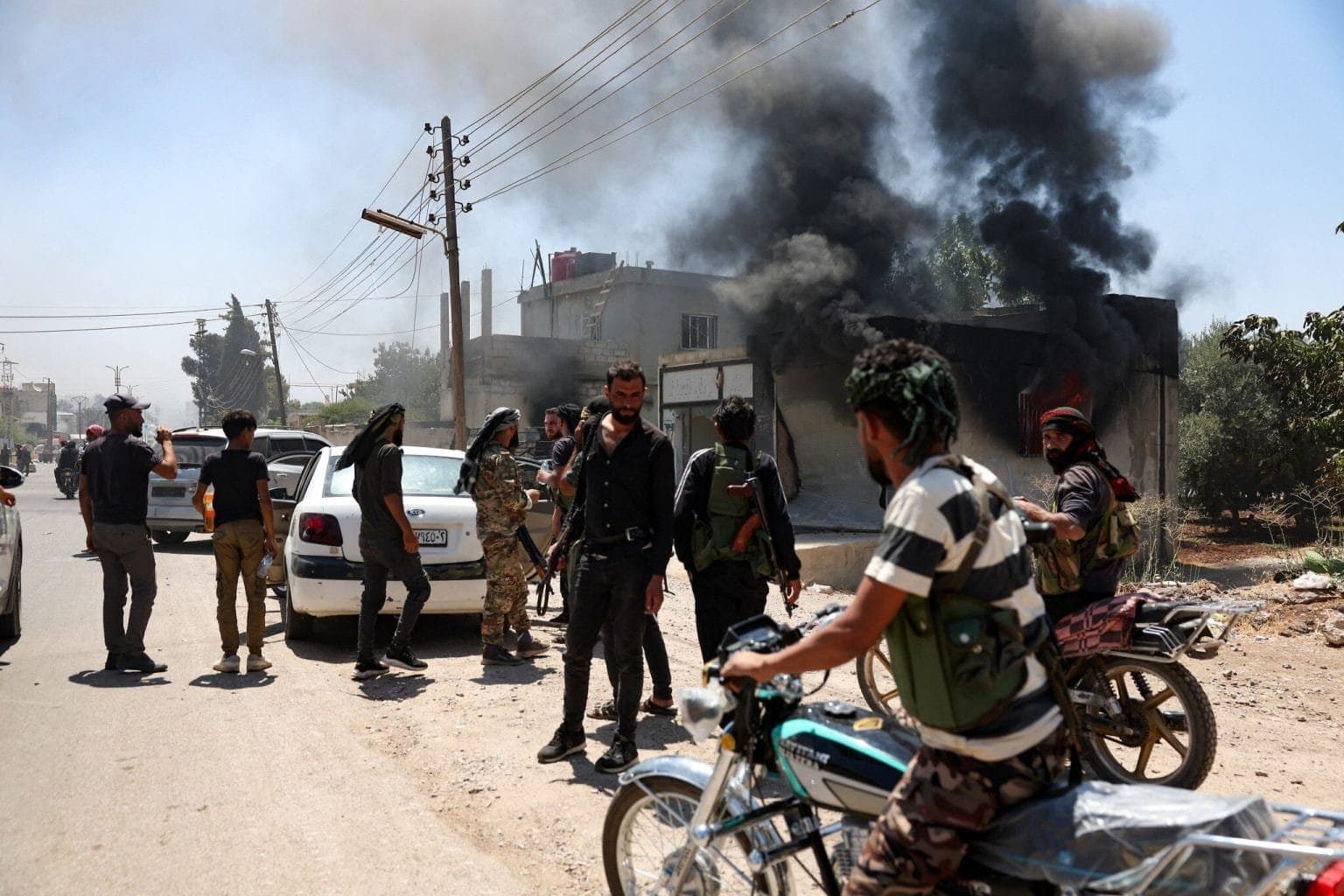
Israel Strikes Syrian Army Camps After Druze Attacks, IDF Says
Key Takeaways
- Israel says it struck Syrian army camps overnight after Druze attacks in Suwayda.
- Targets included a command centre and weapons at Syrian regime bases.
- IDF will not tolerate harm to the Druze in Syria.
Israeli Strikes Overview
Israel's military conducted overnight strikes on Syrian government infrastructure in southern Syria, targeting a command center and weapons stored at army camps.
“Home News Business Energy Opinion Lifestyle Sports Video Podcast Home News Business Energy Opinion Lifestyle Sports Video Podcast Close the sidebar Home News Middle East A drone view of the city of Sweida, following renewed fighting between Bedouin fighters and Druze gunmen, despite an announced truce, in Syria July 18, 2025”
The Israeli Defense Forces (IDF) announced the operation on Friday, claiming it was in direct response to attacks against Druze civilians in the As-Suwayda/Sweida province.

The Israeli military stated it struck 'a command center and combat equipment in Syrian regime military camps in the southern Syria area,' emphasizing this was in response to 'yesterday's events, in which Druze civilians were attacked.'
The IDF declared it 'will not tolerate harm to Druze in Syria and will continue to act for their protection,' while maintaining it continues to monitor developments according to political directives.
Sweida Violence Context
The immediate trigger for the Israeli strikes was reported violence in Sweida province, where clashes erupted between Syrian government forces and Druze factions.
According to the Syrian Observatory for Human Rights, fighting broke out after mortar shells landed in areas controlled by Druze groups in the western countryside of Sweida province.

The Observatory reported the fighting began 'between government forces and fighters from local tribes against opposing Druze factions,' following mortar fire that affected Druze-controlled areas.
The violence later escalated as 'shelling later hit residential neighborhoods in the city of Sweida, sowing panic and fear among residents.'
Local Druze media reported that 'Syrian internal security forces were targeted with mortar shells, following which heavily armed groups from the National Guard Druze paramilitary group were seen moving in the Sweida area.'
Regional Context
The Israeli strikes against Syria occurred against a backdrop of heightened regional tensions following US-Israeli attacks on Iran on February 28, which have roiled the Middle East.
“The IDF will not tolerate harm toDruzeinSyriaand will continue to act for their protection”
Multiple sources noted that 'the latest flare-up between the neighboring countries comes as war roils the Middle East after the United States and Israel attacked Iran.'
This regional context is particularly significant as Syria has largely remained on the margins of the current regional conflict until now.
Syrian President Ahmed al-Sharaa addressed this situation, stating that 'We are calculating our steps with extreme precision and working to keep Syria away from any conflict.'
He emphasized that 'Syria has always been an arena of conflict and strife during the past 15 years and before that, but today it is in harmony with all neighboring countries regionally and internationally.'
The Druze community, an ethnoreligious minority group numbering approximately one million people, primarily lives in Syria and Lebanon, with about 104,000 in Israel including 18,000 in the Golan Heights.
This community holds special status in Israel, with members attaining high-level positions in political, public, and military spheres, which helps explain Israel's stated interest in their protection across the border.
Syrian Response
The Syrian government immediately condemned the Israeli strikes as a violation of sovereignty.
The Syrian Foreign Ministry denounced the attack as 'an outrageous assault on Syria's sovereignty and territorial integrity' and called Israel's justification 'flimsy pretexts and fabricated excuses.'

The ministry characterized the strikes as 'an escalation that continued Israel's policy of interference in internal affairs with the aim of undermining security and stability.'
This condemnation came as Syrian authorities presented an alternative narrative of the events in Sweida, with the interior ministry claiming that security forces had 'dismantled an organised criminal network involving car theft and drug trafficking,' adding that 'nine suspects had been arrested in the operation.'
This version starkly contrasts with accounts from independent monitors and local Druze media.
The violence in Sweida represents part of a broader pattern of internal conflict, with previous clashes between Druze fighters, Sunni Bedouin tribes, and government forces last July leaving hundreds dead.
Government forces have been accused of siding with tribal groups despite claiming to intervene to restore order, with one source reporting that 'government forces were sent in to quell the fighting, but the bloodshed worsened, because the Syrian government forces sided with the bedouins against the Druze resulting in the massacre of 1653 people.'
Israeli Justification
Israeli officials framed the strikes as part of an ongoing commitment to protect the Druze community, with Defense Minister Israel Katz warning of potential further action.
“- Published Israel says it has carried out air strikes on Syrian government infrastructure in the south of the country, in response to what it described as attacks on Druze civilians in Suweida province”
Katz stated that 'Israel will not allow the Syrian government to exploit the wider regional war to target Druze communities, and would strike with even greater force if necessary.'

This represents a significant escalation in Israel's regional posture, particularly as it comes amid the broader Middle East conflict following the February 28 attacks on Iran.
The Jerusalem Post reported that local Druze media had indicated Syrian internal security forces were targeted with mortar shells, followed by movements of heavily armed National Guard Druze paramilitary groups.
This reporting suggests a complex internal Syrian dynamic involving multiple Druze factions.
The strikes also highlight concerns about human rights for minorities in Syria, with ANI News citing an independent international commission of enquiry report from the Office of the UN High Commissioner for Human Rights that found 'minorities have faced abductions, sexual violence, and arbitrary detentions.'
However, the report also noted that 'the new Syrian authorities have taken measures of accountability through the creation of national investigative committees,' indicating some efforts at addressing these violations.
More on Syria
US and Israel Kill Iran's Supreme Leader in Wide-Ranging Strikes
24 sources compared

Israel's Strikes on Lebanon Force Tens of Thousands Back Into Syria as Crossings Reopen
14 sources compared

Syria Deploys Army Units Along Lebanon And Iraq Borders, Says Measure Is Defensive
16 sources compared

Israel and Iran Exchange Strikes; Missile Explosion Kills Four in Sweida
15 sources compared