Iran Hits Bazan Refineries in Haifa Bay with Missiles, Triggers Hazard Assessment
Key Takeaways
- Iranian missiles hit Bazan refineries in Haifa Bay, causing damage.
- Power was briefly disrupted in Haifa, with restoration underway.
- No injuries or casualties were reported from the attack.
Direct Missile Strike
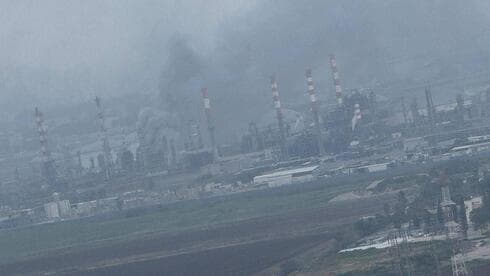
An Iranian missile strike targeted Israel's Bazan oil refinery complex in Haifa Bay on Thursday afternoon.
““Also, in the barrage towards the north, there was no significant damage to Israeli infrastructure sites”
The attack caused damage to the facility and triggered hazardous material assessments across multiple locations.

The strike came as part of a broader barrage that saw sirens sound across much of Israel.
This followed launches from Iran and additional rocket fire from Lebanon.
Iranian media reported the strike as deliberate targeting of Israeli energy infrastructure.
Israeli sources confirmed the refinery site was struck with visible smoke rising from the complex.
The attack represents a significant escalation in regional tensions.
Iran specifically targeted what it described as 'security targets and military support centres of the Zionist regime' according to the Islamic Revolutionary Guard Corps.
Damage Assessment
The attack caused varied levels of damage across Haifa, with reports indicating both direct and indirect impacts.
Israeli authorities confirmed that the missile carried a cluster warhead.

This created multiple impact locations across the Haifa area rather than a single blast site.
Power disruptions were reported in several parts of the city.
These were apparently tied to damage to infrastructure.
Energy Minister Eli Cohen later stated that 'the damage to the power grid in the north is localized and not significant.'
Emergency services responded with 15 firefighting teams dispatched to the Bazan facilities.
Forces conducted extensive searches and worked to extinguish fires that broke out at the site.
One person in Yokneam was reported lightly wounded from shrapnel.
Several others in Shfaram were treated for shock at impact sites.
Cluster Munitions
The missile attack employed cluster munitions, which international human rights organizations have condemned as inherently indiscriminate weapons.
“Cocaine trafficking was a transparent excuse for attacking Venezuela”
According to Israeli Military assessments, about half the ballistic missiles launched by Iran at Israel carried cluster bomb warheads.
These weapons burst open at high altitudes and scatter dozens of smaller bomblets across areas as wide as 10 kilometers.
Chaim Rafalowski, disaster management coordinator of Magen David Adom, described the operational challenge of responding to such weapons.
Each missile creates numerous simultaneous emergencies rather than a single blast site.
Impacts are scattered across neighborhoods and towns rather than concentrated.
Each submunition weighs roughly two and a half kilograms.
Unexploded bomblets remain hazardous on the ground long after civilians leave their shelters.
By the tenth day of the war, Iran had fired a total of 300 missiles at Israel.
Nearly half carried cluster submunitions.
The use of cluster munitions is banned under the 2008 Convention on Cluster Munitions.
This is an international treaty signed by over 100 nations.
Neither Iran, Israel, nor the United States is a signatory to the convention.
Energy Infrastructure Targeting
The attack on the Bazan refinery represents a significant escalation in targeting regional energy infrastructure.
Iran struck at Israel's largest oil processing facility that supplies up to 60% of Israel's transport fuel.

The refinery, operated by the Bazan Group, has an annual capacity of 9.8 million tons of crude oil.
This makes it strategically vital to Israel's economy.
This attack follows a pattern of Iranian targeting of energy facilities.
During the Twelve-Day War with Iran in June 2025, all of Bazan's facilities were temporarily shut down.
This occurred after an Iranian missile strike killed three employees on site.
Iran has intensified attacks across the Gulf region.
They hit Qatar's Ras Laffan LNG hub – which supplies one-fifth of global liquefied natural gas.
This caused a 35% surge in European gas prices.
Iranian strikes also targeted Saudi Arabia, Kuwait, Bahrain, and the UAE.
Facilities in Iran's South Pars gas field and the Asaluyeh region were reportedly attacked.
These attacks caused damage to oil infrastructure across the region.
Regional Escalation
The broader regional conflict continues to escalate with significant economic consequences.
“An Iranian missile attack hit Israel's Oil Refineries in the northern port city of Haifa but did not cause "significant damage", Israel's Energy Ministry said on Thursday”
Oil prices surge above $108 per barrel amid fears of prolonged Gulf disruption.
The violence has spread beyond traditional battlefields.
Iranian missile strikes reportedly killed civilians for the first time in the occupied West Bank.
US military operations have intensified significantly.
The Trump administration carried out more than 7,800 strikes against Iranian targets since February.
These targets included vessels, missile facilities, and defense infrastructure.
While Trump has ruled out deploying thousands of US troops to Iran.
He stated the US is 'not putting troops' in Iran.
The administration continues to weigh military reinforcements.
This occurs as the conflict enters what reports describe as a new phase.
The Economic Times reports that Palestinian civilians were killed in the occupied West Bank.
This occurred by an Iranian missile strike.
This marks a significant expansion of the conflict's reach.
It raises concerns about further regional destabilization.
More on Iran

Iran Attacks Kuwaiti Oil Refinery as Tehran Steps Up Gulf Attacks
21 sources compared

Police Scotland Arrest Iranian Man and Woman After Breach Attempt at Faslane Nuclear Submarine Base
14 sources compared

Israel strikes South Pars gas field; Iran attacked Gulf energy sites
38 sources compared
Iran Targets Gulf Oil and Gas Facilities
74 sources compared