
IRA Victims Withdraw Civil Case Against Former Sinn Féin Leader Gerry Adams
Key Takeaways
- Three survivors withdrew their civil case against Gerry Adams.
- The case concerned IRA bombings in Britain.
- Gerry Adams was named as the defendant.
Case Withdrawal
Three men who survived IRA bombings in England withdrew their civil lawsuit against former Sinn Féin leader Gerry Adams on Friday, with the case being dismissed on what would have been the final day of a two-week trial at London's High Court.
“- Published A civil case against Gerry Adams over three IRA bombings in Britain has been withdrawn”
The lawsuit had accused Adams of bearing direct responsibility and complicity in Provisional IRA decisions to carry out bombings in England during 1973 and 1996, with the victims seeking symbolic damages of 1 pound ($1.34).
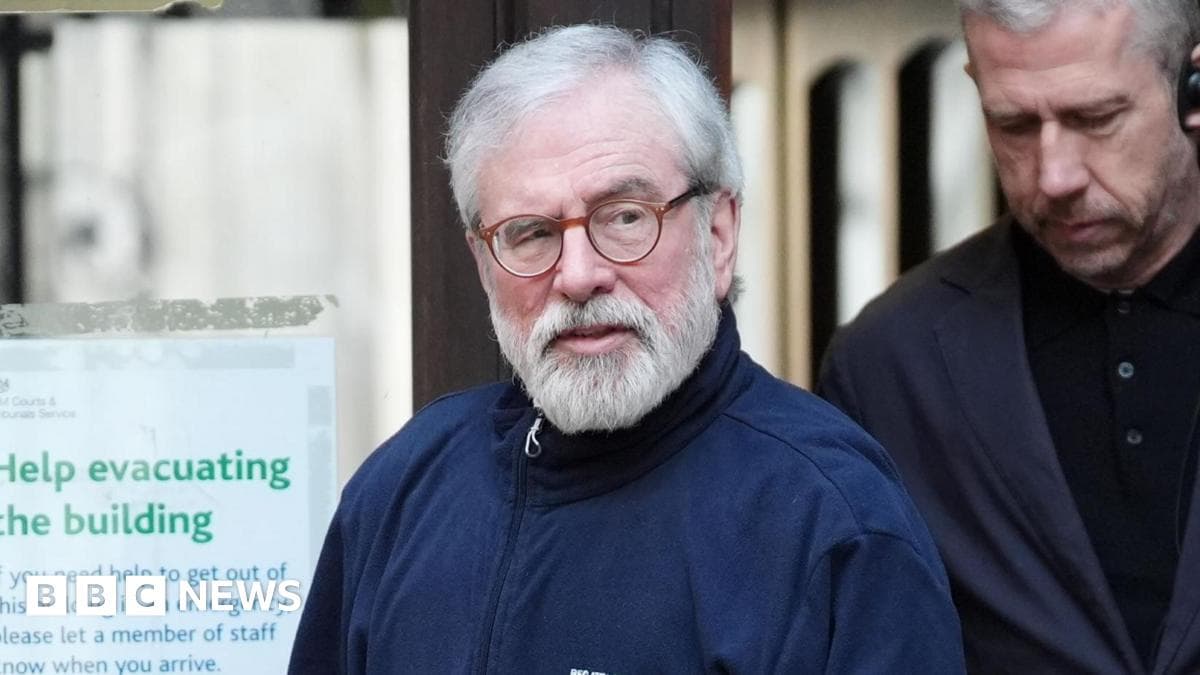
The civil case against Gerry Adams over three IRA bombings in Britain was discontinued with 'no order as to costs,' according to legal announcements.
The trial concluded after nine days of hearings before Mr Justice Swift at the High Court in London, ending the legal battle that had spanned decades since the original attacks occurred.
Allegations and Defense
The victims who brought the case alleged that Adams, 77, was personally liable for injuries they received in IRA attacks in London and Manchester in 1973 and 1996, though the former Sinn Féin leader had consistently maintained he had no role in the explosions.
The former Sinn Féin leader strongly denied being a 'major player' in the IRA, maintaining his innocence throughout the proceedings.
During the proceedings, Adams faced an array of allegations from across several decades, with barristers presenting UK government memos, a letter from US President Bill Clinton, and quotes from Irish ministers as evidence against him.
The case represented an attempt by bombing survivors to hold one of Northern Ireland's most prominent political figures accountable for attacks that occurred decades earlier, despite significant challenges in establishing direct legal liability for historical IRA activities.
Legal Arguments
The decision to withdraw the case stemmed from issues surrounding 'abuse of process,' with Anne Studd KC, representing the three plaintiffs, telling the court that the lawsuit would be withdrawn following 'proceedings developed overnight.'
“Three men who survived IRA bombings in England withdrew their civil lawsuit against former Sinn Féin leader Gerry Adams on Friday”
Adams' legal team had argued throughout the trial that the case was based on 'an assortment of hearsay' and had been brought several decades too late.
They suggested it was not about trying to prove liability for the specific bomb attacks but rather attempting to establish a much wider legal process that 'the court is not intended to perform or is equipped to perform.'
The judge ultimately prevented the victims' legal team from making a public statement about their decision, stating that the court was not 'an opportunity for a public statement' regarding the highly politically charged case.
Adams' Response
Gerry Adams was not present in court on Friday when the case was withdrawn, but he issued a statement welcoming the decision and claiming he had attended the case 'out of respect' for the claimants.
The former Sinn Féin leader maintained that the case should 'never have been brought,' stating that he 'contested this case and defended myself against the smears and false accusations being levelled against me.'
Adams used the opportunity to reassert his political position, declaring that he 'asserted the legitimacy of the Republican cause and the right of the people of Ireland to freedom and self-determination.'
Due to a pre-trial ruling, Adams is unable to recover his legal costs from the claimants, which are believed to be in the six figures, representing a significant financial burden despite the case being discontinued.
More on Britain

Police Scotland Arrest Iranian Man and Woman After Breach Attempt at Faslane Nuclear Submarine Base
14 sources compared
Iran Directs Spying on London Jews as Two Men Face UK Charges
12 sources compared

DOJ Releases First Known Photo Showing Andrew Mountbatten-Windsor and Peter Mandelson With Jeffrey Epstein
17 sources compared
Starmer appoints Peter Mandelson as U.S. ambassador despite warnings over Epstein ties
15 sources compared