
Heavy Rain Triggers Landslide, Kills Over 200 Artisanal Miners at Rubaya Coltan Site in M23-Controlled North Kivu
Key Takeaways
- Heavy rains triggered landslides that collapsed multiple artisanal coltan pits at Rubaya.
- Landslides killed more than 200 people, many bodies still buried and missing.
- Rubaya coltan site lies in M23-controlled North Kivu; rebel authorities reported the toll.
Rubaya mine landslides
Heavy rains in late January triggered sequential landslides that collapsed multiple artisanal coltan pits at the Rubaya mining zone in North Kivu, eastern Democratic Republic of Congo.
“The mine has been under the control of the Rwanda-backed M23 rebel group since 2024”
The landslides killed more than 200 people and left many buried and injured as rescue efforts continued.

Rebel-appointed provincial spokespeople and advisers reported the toll as more than 200 or higher, while some anonymous officials cited a higher figure of 227 in certain accounts.
Independent verification has been limited because of access restrictions and ongoing conflict in the area.
Authorities temporarily halted mining activity and urged residents near unstable ground to relocate.
Search-and-rescue operations continued amid persistent rainfall and the risk of secondary collapses.
Rubaya mining hazards
Eyewitnesses, former miners and several outlets describe working conditions in Rubaya as highly unsafe.
They report hand-dug pits and narrow tunnels lacking reinforcement or drainage, with excavated material often piled nearby and multiple parallel shafts that can trigger cascading collapses when saturated by heavy rain.
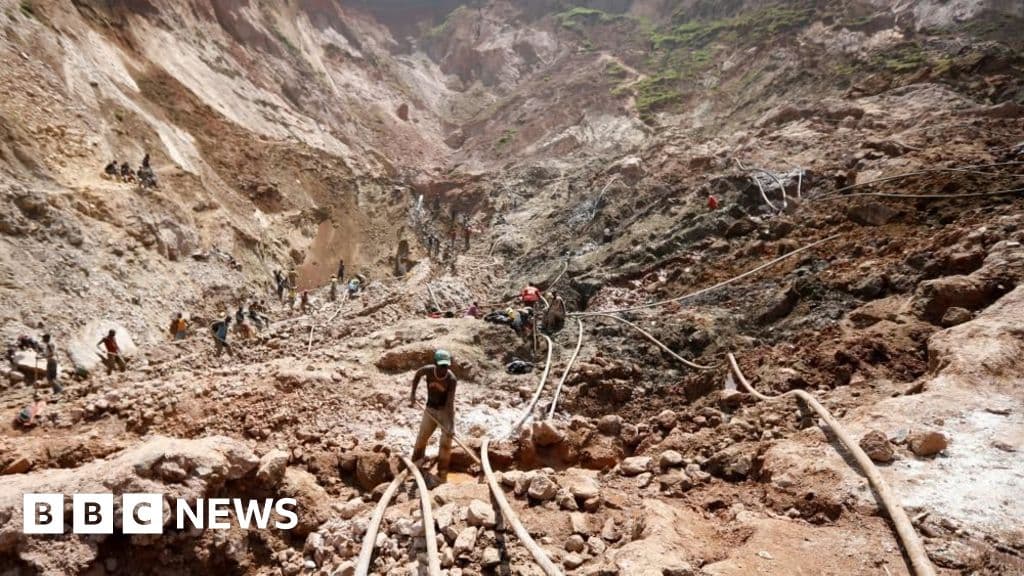
Reports say miners, including children and market vendors, dig for a few dollars a day, increasing exposure to seasonal hazards, and local accounts attribute an initial failure that propagated through adjacent pits to rapid water infiltration and destabilized slopes.
Rubaya mine control and revenue
The Rubaya site sits within the contested, mineral-rich landscape of eastern Congo and has been under the control of the M23 rebel group since 2024.
“At least 200 were killed when mines collapsed at a coltan mining site in eastern Congo this week, rebel authorities say”
Several outlets report that M23 collects taxes or fees on coltan production, and the U.N. has accused the group of using those revenues to fund its insurgency.
Kigali denies these allegations.
Some reports quantify the mining revenue attributed to M23 control, citing a U.N. figure of roughly $800,000 a month.
Other sources emphasise only that the site is taxed or looted, showing variation in how outlets contextualise the political economy of the mine.
Response and access challenges
Response operations and humanitarian access have been constrained by unstable terrain, ongoing rain and conflict-related access limits.
Local health centres were reported as overwhelmed, and some injured were evacuated to Goma.

Officials cautioned that poor roads, lack of equipment and the risk of secondary collapse were impeding rescue work.
Rebel provincial authorities ordered an initial safety assessment, suspended artisanal mining and relocated nearby residents.
However, limited oversight and insecurity complicate hazard mitigation and verification of casualties.
Eastern Congo mining crisis
Many outlets have framed the disaster as part of a recurring pattern in eastern Congo: vast mineral wealth extracted under dangerous, informal conditions amid widespread poverty, displacement, and recurrent violence.
“Over 200 people were reportedly killed in a collapse at the Rubaya coltan mine in easternDemocratic Republic of the Congo (DRC)on Wednesday”
Coverage often includes statistics on Rubaya’s share of the global coltan and tantalum supply and warnings about frequent, deadly mine incidents.
&w=3840&q=75)
Some sources emphasize inequality and livelihoods while others focus on production figures and security implications within the wider humanitarian crisis in eastern DRC.
More on DR Congo

Drone Strike in Goma Kills French UN Aid Worker; M23 Blames Congolese Forces, Kinshasa Denies
10 sources compared
M23 Rebels Accuse Congolese Army of Drone Strikes That Kill French Aid Worker in Goma
10 sources compared

Rwanda-Backed M23 Rebels Seize Uvira, Refugees Say Rebels Killed Neighbors and Displaced Thousands
12 sources compared

Trump Brokers Deal With Rwanda, DRC to Open DRC's Critical Mineral Reserves to U.S. Companies
12 sources compared