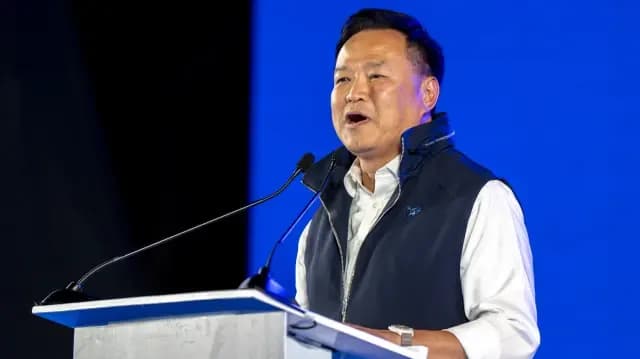
Anutin Charnvirakul Wins Reelection as Thailand's Prime Minister
Key Takeaways
- Anutin Charnvirakul re-elected Thailand's prime minister after parliamentary vote.
- Bhumjaithai Party secured support from more than half the 500-seat House.
- The reelection follows the party's February election victory, signaling potential stability.
Parliamentary Victory
Anutin Charnvirakul has been re-elected as Thailand's Prime Minister following a decisive parliamentary vote on March 19, 2026.
“Anutin Charnvirakul re-elected as Thailand's prime minister Anutin of Bhumjaithai Party secured support of 293 lawmakers in 500-seat lower house ISTANBUL Anutin Charnvirakul of the Bhumjaithai Party was re-elected as prime minister of Thailand on Thursday, according to state-run Thai PBS”
The 59-year-old leader of the Bhumjaithai Party secured 293 votes in the 500-seat House of Representatives, comfortably exceeding the required threshold of 249 votes.

His nearest rival, Natthaphong Ruengpanyawut of the progressive People's Party, received only 119 votes, with 86 lawmakers abstaining.
A total of 497 of 500 parliamentary members were present for the vote.
This parliamentary approval comes after Anutin's Bhumjaithai Party emerged as the largest political force in February's general election.
The party won 193 seats though falling short of the 251 seats required to govern independently.
The re-election represents a significant political milestone in Thailand's turbulent democratic history.
Historic Milestone
Anutin's victory marks the first time in two decades that a Thai prime minister has been successfully re-elected to office.
This highlights both his political acumen and the profound instability that has characterized Thailand's democratic evolution.
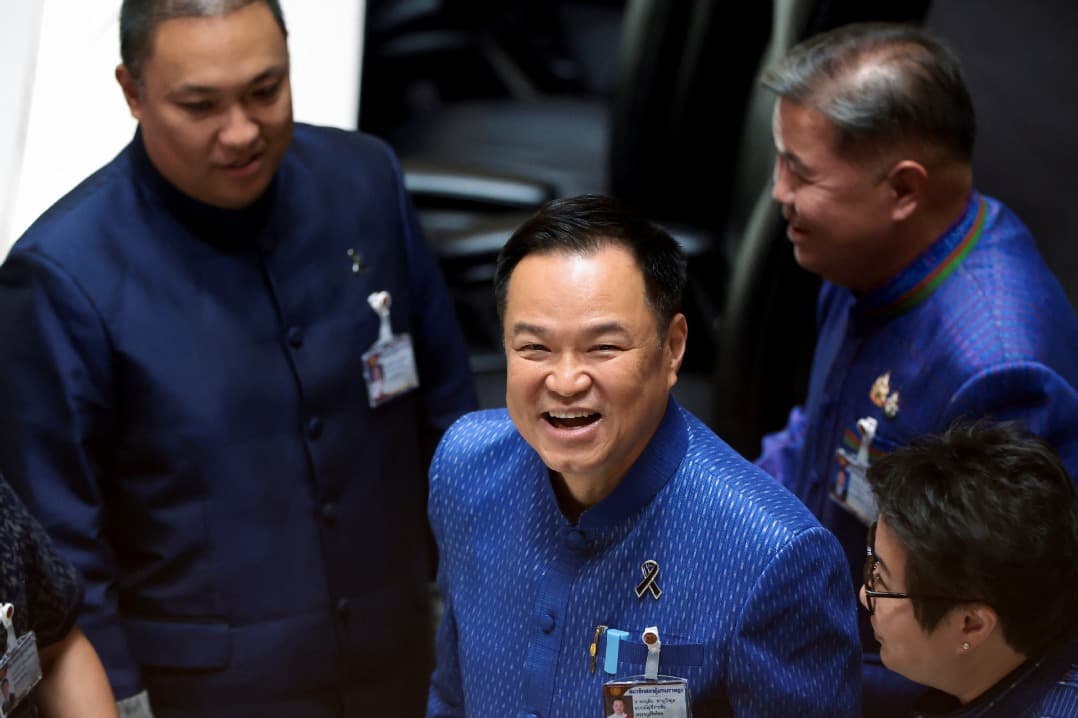
The 59-year-old politician becomes Thailand's 32nd Prime Minister.
He is positioned to lead a coalition government expected to control 292 of the current 499 seats in parliament.
This electoral success comes after Anutin first assumed office in September 2025 following the dismissal of Paetongtarn Shinawatra.
This demonstrates his remarkable ability to navigate Thailand's complex political landscape.
His reelection represents a significant departure from Thailand's recent pattern of short-lived governments.
It suggests a potential shift toward greater institutional stability.
Coalition Strategy
The formation of Anutin's government represents a masterclass in political coalition-building.
“BANGKOK: Anutin Charnvirakul was re-elected Thailand's prime minister on Thursday (Mar 19) after sailing through a parliamentary vote, winning a fresh mandate that could usher in a rare period of stability for a country long plagued by political drama and turmoil”
This is particularly through his strategic alliance with the Pheu Thai Party despite their previous political differences.
Following February's election results, Bhumjaithai secured 193 seats, People's Party won 118 seats, and Pheu Thai captured 74 seats.
Anutin successfully secured crucial support from the Pheu Thai Party, which is backed by influential former Prime Minister Thaksin Shinawatra.
This political maneuvering allowed Anutin to consolidate the parliamentary majority needed for his re-election.
The coalition is expected to control 292 seats.
Anutin's approach reflects his reputation as a pragmatic politician.
He can straddle political divides and position his party strategically between warring elites.
Stability Prospects
Anutin's reelection carries significant implications for Thailand's political stability and economic future.
This comes at a time when the country faces substantial economic challenges.

The 59-year-old prime minister has pledged to address Thailand's problems immediately.
He stated that 'your voices are equally heard' and vowed to work on forming a cabinet.
Thailand's economy has been described as 'long-stuttering' and shackled by massive household debt.
The country also faces headwinds from trade uncertainty and fallout from the US-Israeli war on Iran.
Analysts suggest Anutin's survival instincts could prove crucial in addressing these economic challenges.
His government may benefit from rare alignment between institutional power structures and political leadership.
International Response
Internationally, Anutin's reelection has been met with positive reaction, particularly from China.
“Anutin Charnvirakul: Navigating the Political Maze to Premiership Anutin Charnvirakul, leader of Thailand's Bhumjaithai party, was reelected as Prime Minister following February's election win”
China has congratulated him on assuming office again as Thailand's prime minister.

China's Foreign Ministry spokesman Lin Jian expressed confidence that under Anutin's leadership, Thailand 'will make new and greater achievements in its national development.'
This signals expectations for future developments in China-Thailand relations.
The international community is watching closely to see how Anutin's government will navigate Thailand's foreign policy.
This comes amid regional geopolitical tensions.
As a staunch royalist who has weathered two decades of political upheaval, Anutin's ability to maintain Thailand's traditional foreign policy alignments will be closely scrutinized.
This scrutiny extends to both regional observers and international partners.
More on Asia

Drone strike at Dubai International Airport shuts down flights; attacker unconfirmed.
50 sources compared
Iran Strikes Italian Military Base in Erbil, Forcing Troops Into Bunkers
28 sources compared
Former South Korean president Yoon Suk-yeol appeals life sentence for leading insurrection
14 sources compared
Diet Re-elects Sanae Takaichi as Prime Minister of Japan After LDP Landslide
14 sources compared