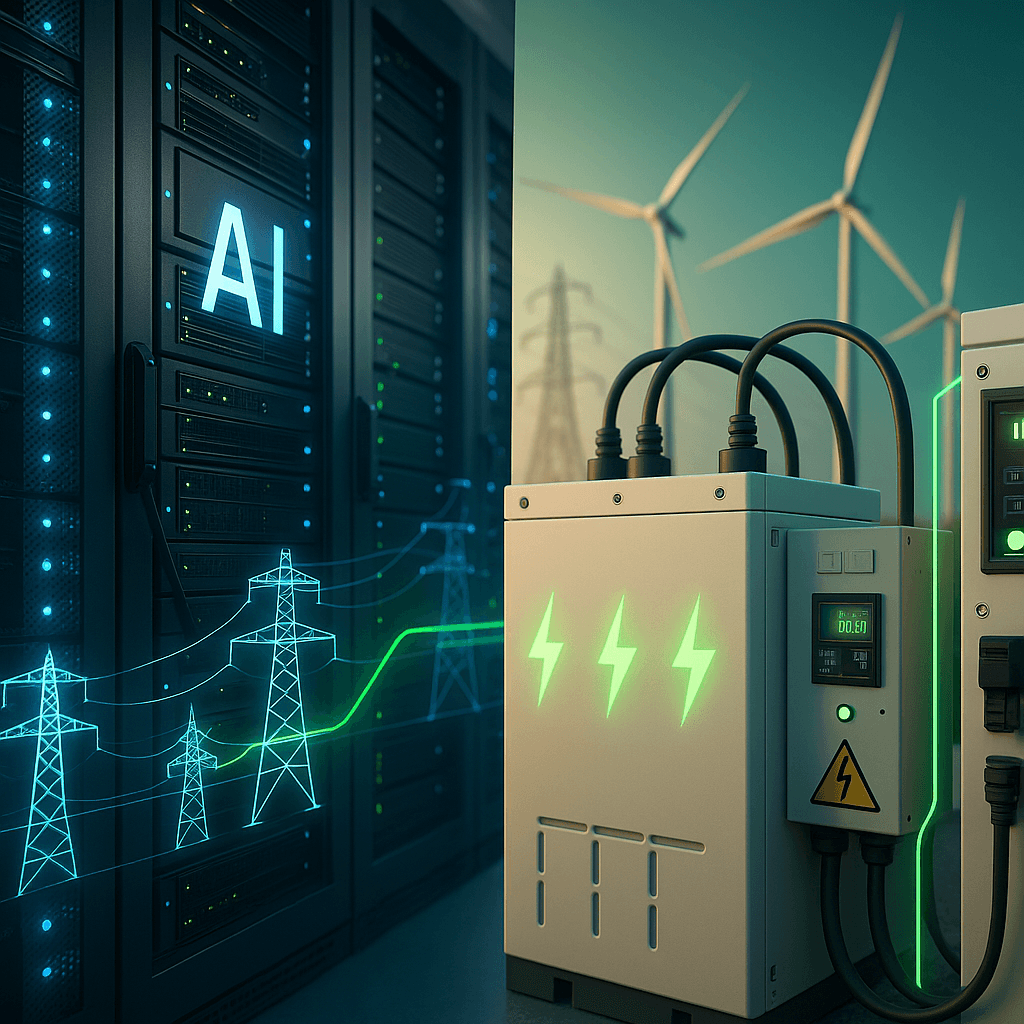
AI power crunch opens $100B+ energy tech investment wave
Key Takeaways
- AI-driven data-center power constraints delay projects and prompt capital shift to energy tech.
- Venture capital pivots toward energy-tech and energy-infrastructure amid data-center bottlenecks.
- Up to half of announced data-center projects delayed due to power constraints.
Power Crisis Emerges
The artificial intelligence boom has collided with a fundamental infrastructure constraint: a nationwide power grid that cannot keep pace with the exponential growth in data center demand.
“Rapid AI growth is straining data center power supplies and delaying many projects, forcing investors to reassess where to allocate capital”
TechCrunch reports that these grid shortages are unprecedented in modern times, driving up electricity prices and forcing major technology companies to explore alternative power sources.

The Trump administration has even intervened, sensing a looming political crisis and urging tech companies to build their own power capacity or pay higher rates.
This energy bottleneck represents the single biggest roadblock to building new data centers, as The Tech Buzz describes, creating a critical constraint that no amount of venture funding can quickly solve.
The scale of the problem is staggering, with Tech Buzz noting that a single large-scale AI training cluster can consume as much power as a small city.
Some facilities requiring 500 megawatts or more, enough to power roughly 375,000 homes 24/7 with near-perfect reliability.
Investment Wave Builds
This critical power shortage has triggered a massive realignment of capital flows across the technology sector, creating unprecedented opportunities in energy infrastructure investments.
The Tech Buzz reports that energy infrastructure startups have suddenly become the hottest tickets in town, with venture capital increasingly flowing toward solutions to the AI industry's energy consumption challenges.

According to mezha.net's analysis, up to 50% of announced data centers may face delays due to power issues, creating significant opportunities for investors looking at rising demand for AI services and energy supply needs.
The Tech Buzz further explains that this infrastructure crunch is quietly redirecting capital flows across the tech industry, with energy storage companies, grid management platforms, and alternative power providers fielding term sheets at valuations that seemed impossible just 18 months ago.
This represents a fundamental shift in investment priorities as technology companies recognize that securing reliable electricity has become a harder challenge than developing AI algorithms themselves.
Tech Industry Solutions
The technology industry's response to this power crisis has been multifaceted, involving both direct investments in alternative energy sources and the development of innovative energy management solutions.
“The AI boom has hit a wall, and it's not made of silicon”
TechCrunch highlights that Amazon, Google, Oracle, and other large tech companies have been working to minimize their dependence on the traditional grid, with several data centers being planned using on-site power or hybrid approaches.
Google has emerged as a leader in this space, with TechCrunch reporting that the company's latest deal to power a new data center in Minnesota blends wind and solar with a massive 30 gigawatt-hour battery from Form Energy.
mezha.net expands on this trend, noting that Google and Meta are actively spending on renewable energy and energy-efficient solutions, investing in solar and wind energy as well as nuclear technologies.
The company is also supporting promising developments like the Form Energy 100-hour battery through direct investments and close engagement with utilities to accelerate their deployment.
Dozens of startups are now working on various approaches to overcome power delivery issues, with companies like Amperesand, DG Matrix, and Heron Power developing energy convergence solutions.
Camus, GridBeyond, and Texture are creating software to manage energy flows more efficiently.
Market Projections
The market opportunity created by this AI power crisis is projected to be substantial, with analysts estimating investments could exceed $100 billion as the industry scrambles to address the energy infrastructure deficit.
mezha.net provides concrete data showing that global data-center capacity currently stands at about 190 gigawatts, with only 5 gigawatts under construction and roughly 6 gigawatts coming online last year.
The site also reports that roughly 36% of projects in 2025 have faced schedule delays due to power constraints, highlighting the severity of the supply-demand imbalance.
Looking forward, mezha.net projects that AI could increase data center electricity consumption by about 175% by 2030, further exacerbating the current shortage.
This exponential growth in energy demand, coupled with the antiquated nature of existing grid infrastructure and shortages of power generation equipment like gas turbines, has opened the door for long-term investments in energy solutions.
The Tech Buzz frames this as a straightforward business opportunity: whoever solves AI's power problem stands to capture enormous value as the technology scales, making energy infrastructure startups among the most promising investment targets in the current tech landscape.
Industry Transformation
This energy transformation is fundamentally reshaping the technology industry's approach to infrastructure and creating new competitive dynamics among major players.
“Venture capitalists have placed increasingly bigger bets on AI startups, investing over half a trillion dollars into the sector over the last five years”
The shift has been driven in part by shortages of power generation equipment and an antiquated grid, as noted by TechCrunch, which has opened the path for alternative energy sources and innovative business models.
TechCrunch also reveals that less than a quarter of projects that have identified a power source will use on-site or hybrid solutions, but together they represent 44% of total capacity, indicating that the largest and most ambitious data center projects are leading the transition away from traditional grid dependence.
According to mezha.net, the imbalance between supply and demand for energy opens the door for long-term investments that could redefine the competitive landscape.
The Tech Buzz emphasizes that while Microsoft, Google, and Amazon have poured billions into AI chips and models, they're now discovering that securing reliable electricity has become the harder challenge.
This realization has prompted major tech companies to work with utilities to devise new rate structures and accelerate the deployment of new technologies, as Google did with Xcel Energy in Minnesota.
The energy tech investment wave represents not just a response to current constraints but a fundamental rethinking of how the technology industry powers its future growth.
More on Technology and Science

Trump Unveils National AI Policy Framework to Preempt State Laws
20 sources compared

Social media damages youth well-being, World Happiness Report 2026 finds
34 sources compared

Meta Pays Creators Up to $3,000 to Post on Facebook, Launching Creator Fast Track.
25 sources compared

Climate Change Drives Record March Heat in Southwest U.S.
14 sources compared